
Howrah Station Metro
The promise and the pain

After a long wait, there is promise in the air. Promise that the trip across the river from Howrah Station and into the downtown heart of Kolkata can be achieved in a matter of 5-10 minutes, instead of the good 30-40 minutes that it takes right now. The underwater tunnel of the East-West Kolkata Metro line is complete, and while the line as a whole remains incomplete, with the stretch between Sealdah Station and Esplanade still pending, there is hope that at least the stretch between Howrah Maidan and Esplanade can be made operational for commuters by the end of 2023. With the line connecting to the existing North-South Metro at Esplanade and given that the future Joka Line will also terminate at Esplanade, it will be a huge relief to commuters (“daily passengers” in the local parlance) for whom the daily trip to and from different parts of the city and Howrah Station is a necessity.
The Question of Access
Given so much hope in the air, I hate to be the bearer of negative energy. But a few questions do arise while talking about this development. Like for instance, given that the Howrah Railway Station Metro Station will be the deepest in India (34 meters or 5 floors down), and given that Indian Railways’ Howrah Station is one of the largest stations in the world (over half a kilometer separates Platform 1 and Platform 23), how will the access from different parts of the station be like?
The answer is already known- not great! You see, the new metro station is located between the two separate, but adjacent terminals in the railway station, that serve Eastern and Southeastern Railway trains. It is the only place where the metro station could have come up. What that means is that all passengers who want to use the metro will be funneled into that one corridor to access the metro, creating a huge bottle neck.
Howrah Station platforms are only connected through the common concourse area at the head of the platforms, where the tracks end. Being a terminus, there is no FOB or subway linking the platforms in the middle. While it wasn’t an issue earlier, since almost everybody de-boarding at the station would move towards the head of the platforms to exit the station anyways to access the bus and taxi terminals, it will be an issue now.
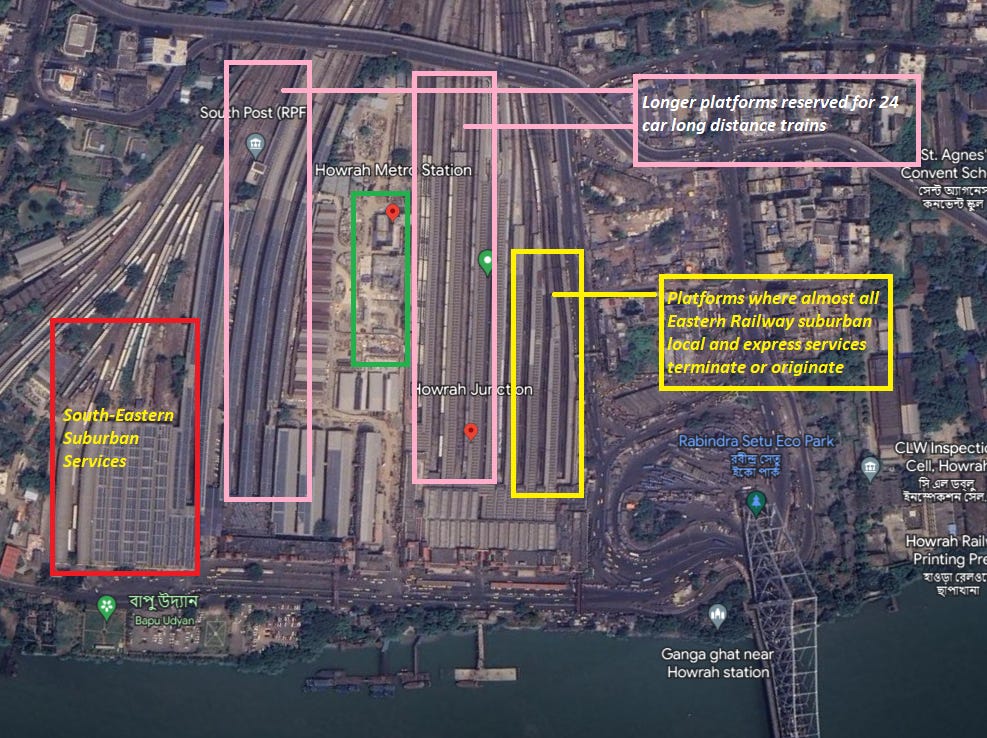
Courtesy- Google Earth
I have on occasion used the station to connect with another train. So, you can change from Eastern Railways to the Southeastern services or vice versa. Now, the majority of these connections are long distance ones. There are hardly any daily commuters who change trains from one suburban service to the other. But the rare ones who do or anyone who has (like I have) know the pain of moving from Terminal 1 (Eastern) to Terminal 2 (Southeastern). The connectivity between the two concourses is so poor (and not at all disabled friendly if I may add) that it almost easier to exit the station, walk along the station building on the street outside and re-enter from the main entrance of Terminal 2 (Southeastern). With the majority of commuters moving en masse towards the gap between the two terminals, you can understand why my fears about possible stampedes are pretty legitimate.
Who Is It For?
When you are building public transport infrastructure, who do you build it for? Who is your primary target group? The answer is obviously the daily commuter, the one who will use the system most and in turn pay for it directly. In the case of Howrah Metro Station, that group is the collective set of daily passengers(commuters) which uses the Eastern and Southeastern branches of Kolkata’s Suburban Railway services that culminate/start from the Howrah Railway Station. So far so simple, right? However, while the Southeastern services are located fairly close to where the metro station is being built, a majority of the services on the larger, Eastern branch terminate/start from platforms that are pretty far away. The platforms of Eastern Railways Suburban (called Local) services nearest to the metro station currently mostly operate out of platforms 1 and 6. The platforms closer to the metro station are mostly used for long-distance trains or regional express trains. That means, the people who will use the service most are currently the farthest away from it. Given that long distance journeys in India mostly imply carrying significant luggage too, I doubt how many long-distance passengers will brave using, what is obviously going to be a very overcrowded metro line. They might still prefer buses and taxis. So, unless the Indian Railways and Howrah Railway Station management decide to change things around significantly, there is still significant pain in store for the average commuter.
Solutions?
There are a few things that the authorities can try here.
1. To build a FOB or an underground subway connecting all platforms of the Indian Railway’s Howrah station directly with the metro station concourse, bypassing the common concourse of the mainline railway terminus. Access should be provided from the middle of all platforms, so that the volume of people who want to board the metro can can be funneled through their own dedicated corridor, preventing the Howrah Station common concourse, that also has the waiting area and commercial establishments, from getting overcrowded.
If the authorities feel, as I do, that the overwhelming majority of metro passengers will be from the suburban line platforms, there can be selective access to the subway/FOB too, with access given only to the pertinent platforms serviced by suburban local and regional express trains. Platforms reserved for long distance trains can be excluded from such access. There is ample space for a FOB (which I am guessing will be the easier of the two, although a subway will be more optimal, since it will require shorter escalators and stairs.
2. Change the platform configuration in Howrah Railway Station, moving long distance trains more towards platform 1 to 10 and concentrating suburban (local) and regional express trains on platforms 11 to 17. It might mean extending the length of certain lower denomination platforms. But it will allow for a small FOB or subway to be built, off-setting final costs.
Is a two-track service enough?
It does not take a genius to understand why this line will be one of the most heavily used anywhere in the world. That means overcrowding will be a serious problem, even during off-peak hours. The authorities must constantly be on guard and must have effective plans in place for stampede like situations, which will happen almost daily. So, it naturally begs the question, is a single two-track service enough? Or should Kolkata Metro have made provisions for another two-track tunnel for a future service, possibly extending the Joka Line to Howrah Station. There is ample space to add two more platforms in a separate, but adjacent station box. It will certainly cost a lot, but in the long run be extremely beneficial.
The East-West line is more a East-North West line, that connects Kolkata’s important North Western suburbs of Salt lake and Rajarhat (with one future change at Sector 5 station) with Howrah Station. However, for passengers going to the dense Southern suburbs of Behala, they must change at Esplanade, as the Joka line will terminate there. If it were to continue upto Howrah through a second tunnel beside the East-West metro, a direct connection between Kolkata’s Southern suburbs and Howrah station could have been come into existence. By taking away all passengers who are travelling towards South of the Kolkata metropolitan area, it would have eased the crush in not just the East-West line, but also but also Esplanade, which is going to be a massive tri-junction.